Industry

Healthcare technology built for regulated environments

Application development, integration and data work for healthcare organizations operating under privacy and audit obligations.

The situation

What we typically find

These are the conditions that usually bring an organization to us.

  • Integration between clinical and administrative systems
  • Protecting regulated data without blocking legitimate access
  • Reporting across fragmented sources
  • Modernizing systems that cannot be taken offline

Capabilities

What we deliver

Systems integration

Interfaces between clinical, scheduling and billing platforms.

Data and reporting

Governed reporting across operational and administrative data.

Security and privacy

Access control, auditability and retention against policy.

Application modernization

Incremental replacement of legacy applications.

What we build

Systems we deliver in this sector

Interfaces between clinical, scheduling, billing and administrative systems

Governed reporting across fragmented operational data

Access control, audit trails and retention aligned to policy

Patient- and staff-facing applications built to accessibility standards

Incremental modernization of systems that cannot be taken offline

Constraints we design around

What makes this sector different

Regulated data changes the design

Access, logging and retention are architectural decisions here, not features added before an audit.

Availability is not negotiable

Migration and release plans assume the system stays reachable throughout.

Experience

Relevant experience

Manufacturing

Product traceability and production management

Challenge
Production and supply records were held in systems that could not be reconciled, so a unit could not be traced back through its production history.
Approach
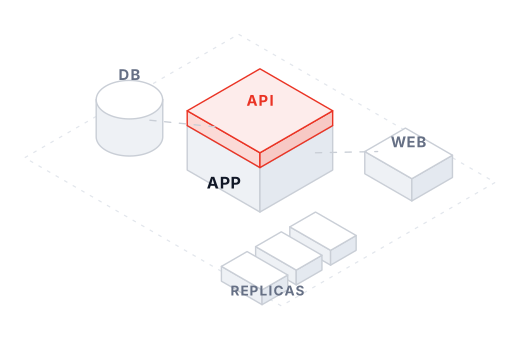
Built a shared traceability record spanning production and distribution events, with each step written once and readable by every downstream system.
  • Distributed ledger
  • Systems integration
  • Web application

Operations

Online warehouse management system

Challenge
Stock movement, locations and fulfilment status were tracked manually, leaving inventory accurate only as of the last count.
Approach
Modelled the real warehouse process first — receiving, put-away, picking, dispatch — then built to it rather than to a generic inventory template.
  • Web application
  • Relational database
  • Role-based access

Applied AI

Voice-driven AI reservations and ordering

Challenge
Orders and reservations arrived by phone and had to be transcribed by staff, which capped throughput at busy periods.
Approach
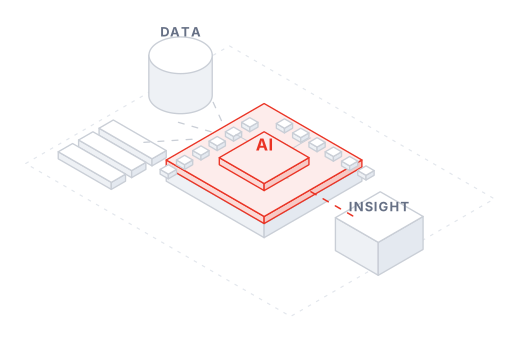
Applied speech recognition and intent handling to the narrow, high-volume part of the conversation, leaving staff to handle exceptions.
  • Speech recognition
  • Natural language processing
  • Mobile application

Talk to an Expert

Describe the problem and the constraint. We will tell you how we would approach it.